London: Test cricket finally has a league table that matters. The ICC World Test Championship, launched in 2019, gives every bilateral series context beyond rankings — with a trophy and a Lord’s final at stake. Here is the complete guide to how it works.
The Format: Two Years, Nine Teams, One Final
The current 2025–27 cycle — the fourth edition — began on 17 June 2025 with Sri Lanka vs Bangladesh in Galle and will conclude with the final at The Oval in June 2027. Nine of the ICC’s twelve full members participate: Australia, Bangladesh, England, India, New Zealand, Pakistan, South Africa, Sri Lanka and the West Indies. (Afghanistan, Ireland and Zimbabwe do not take part.)
The league stage comprises 27 series and 71 matches. Each team plays six series — three at home and three away — with each series containing between two and five Tests. The top two teams in the standings at the end of the league stage qualify for the final. Tiebreakers, in order, are: number of series wins, away-match percentage, and finally the ICC Test rankings.
The Points System
Every Test carries the same weight regardless of series length — a change from the first cycle, where a win in a two-Test series was worth 60 points but only 24 in a five-Test series. The current system is simple:
Win: 12 points (100% of points contested)
Tie: 6 points each (50%)
Draw: 4 points each (33.33%)
Loss: 0 points
Crucially, teams are ranked not on total points but on percentage of points won (PCT) — points earned divided by points contested. This keeps the table fair when teams have played different numbers of matches. There is also a disciplinary edge: teams lose one championship point for every over they fall behind the required over rate (unless they bowl the opposition out within 80 overs).
So a team that wins 2-0 in a two-Test series (24 of 24 points) sits at 100%, while a team that draws 1-1 in a five-Test series with three draws would hold a far lower percentage despite playing more cricket.
History: Three Finals, Three Stories
2019–21: New Zealand defeated India by eight wickets in the inaugural final at Southampton, with Kyle Jamieson starring in overcast English conditions.
2021–23: Australia beat India by 209 runs at The Oval, with Travis Head’s 163 and Steve Smith’s century burying India after they were asked to follow a familiar script of final-day collapse.
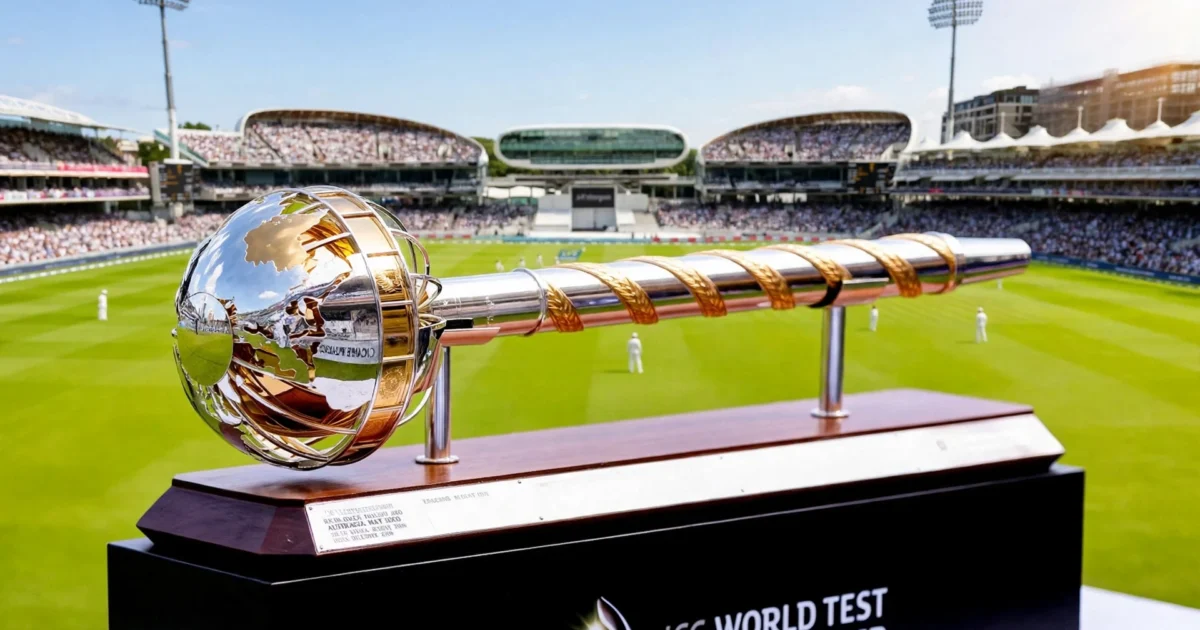
2023–25: South Africa ended years of knockout heartbreak by beating Australia at Lord’s in 2025, with Temba Bavuma’s men chasing down 282 — Aiden Markram’s century the defining innings — to lift the mace.
India, notably, have reached two finals and lost both — a record that stings and shapes every cycle.
The 2025–27 Race: Where Things Stand
As of October 2026, Australia lead the table at around 80% after 10 matches (8 wins), with defending champions South Africa second at 75% and New Zealand third at 72.22%. Bangladesh sit a surprise fourth at 55.56% after a historic series win in Pakistan. India are fifth at 51.52% after 11 matches (5 wins, 4 losses, 2 draws) — their drawn second Test in Colombo against Sri Lanka in August 2026 cost them eight points and seriously dented their margin for error. England languish in sixth despite playing the most cricket, hurt badly by 14 points docked for slow over rates. Sri Lanka, West Indies and Pakistan round out the table.
With the final at The Oval in June 2027, every series from here carries double weight — particularly India’s remaining fixtures and the Ashes contests that always reshape the table.
Why It Matters — And the Criticisms
Before the WTC, most bilateral Test series existed in a vacuum — dead rubbers were common and context was whatever commentators invented. The Championship gives every match a tangible consequence: points toward a final. It has produced genuine jeopardy, from India’s famous Gabba chase in 2021 (which secured their final spot) to South Africa’s nerve-shredding Lord’s triumph.
The criticisms are fair, though. Not every team plays every other team, so the fixture list is inherently unequal — some sides face tougher schedules than others. The two-year cycle means teams can go stale waiting for relevance, and the points-percentage system, while fairer than raw totals, still confuses casual fans. Purists also note that a single final can feel like a lottery after two years of grind.
Imperfect or not, the WTC has done something Test cricket desperately needed: it made people care about the table. When Australia tour South Africa or India head to England, it is no longer just a series — it is a final qualification battle. And that is exactly what the format was built for.