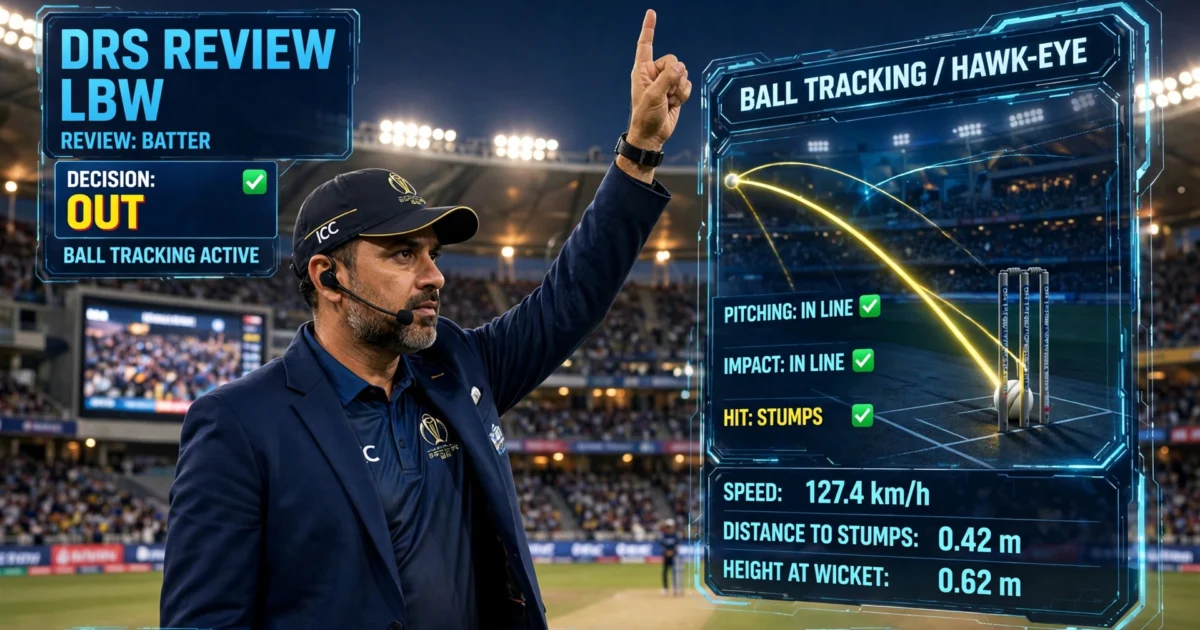
The Decision Review System (DRS) lets players challenge on-field umpiring decisions using technology. Introduced to eliminate obvious errors, it has become one of cricket’s most debated innovations.
How a Review Works
Each team gets a limited number of unsuccessful reviews per innings (usually two in Tests, one in white-ball cricket). The captain or batter must signal for a review within 15 seconds of the decision. The third umpire then examines the available technology.
Ball Tracking (Hawk-Eye)
For LBW decisions, ball-tracking predicts the ball’s path: where it pitched, where it hit the pad, and whether it would have hit the stumps. If the prediction shows the ball hitting the stumps, the on-field decision can be overturned.
UltraEdge / Snicko
To detect bat-pad or glove contact, UltraEdge (formerly Hot Spot and Snicko) analyses sound and thermal imaging. A spike as the ball passes the bat indicates an edge — crucial for caught-behind and LBW reviews.
Umpire’s Call
Cricket’s most controversial concept. When ball-tracking shows a marginal decision — the ball clipping the stumps rather than hitting them flush — the on-field call stands. Umpire’s call acknowledges the technology’s margin of error and protects umpires on 50-50 calls.
DRS Controversies
Debates rage over umpire’s call, the number of reviews, and whether technology should have the final say. What is certain is that DRS has removed the howler — the obviously wrong decision — from top-level cricket.